



Prayer has been part of my Christian life for as long as I can remember.
I’ve prayed for family members, finances, health, ministry, and countless everyday needs. Like many believers, I’ve had seasons where my prayer life was vibrant and others where it felt repetitive—as though I was praying the same prayers about the same struggles over and over again.
It wasn’t that God wasn’t listening.
It was that I hadn’t stopped to ask Him a different question.
Instead of only asking Him to remove the battle, what if I asked Him how to fight it?
That simple shift changed the way I approached prayer.
The Bible tells us that we have an enemy who “comes only to steal and kill and destroy” (John 10:10). Peter warns us that our adversary prowls around like a roaring lion, looking for someone to devour (1 Peter 5:8). Paul reminds us that we aren’t wrestling against flesh and blood but against spiritual forces of darkness (Ephesians 6:12).
If our enemy is intentional, shouldn’t our prayers be intentional too?
I’m not talking about complicated formulas or saying the “right” words.
I’m talking about bringing a specific battle before the Lord and asking Him for His wisdom instead of simply reacting every time the enemy attacks.
James tells us that if anyone lacks wisdom, we should ask God, who gives generously without finding fault (James 1:5). What an incredible promise! God doesn’t leave us to figure out spiritual battles on our own. He invites us to seek Him, and He promises to give us the wisdom we need.
When I think about Jesus, I’m struck by how intentional His prayer life was.
He often withdrew to lonely places to pray. Before choosing the twelve disciples, He spent the night in prayer. Before going to the cross, He prayed in Gethsemane with complete honesty, surrendering His own will to the Father’s.
Jesus never treated prayer as an afterthought.
It was where He received strength.
Direction.
Wisdom.
Peace.
Over time, I found myself following the same simple process whenever I was facing a spiritual battle. It helped me move beyond vague prayers and begin seeking God’s wisdom for the specific battle in front of me.
It looks something like this:
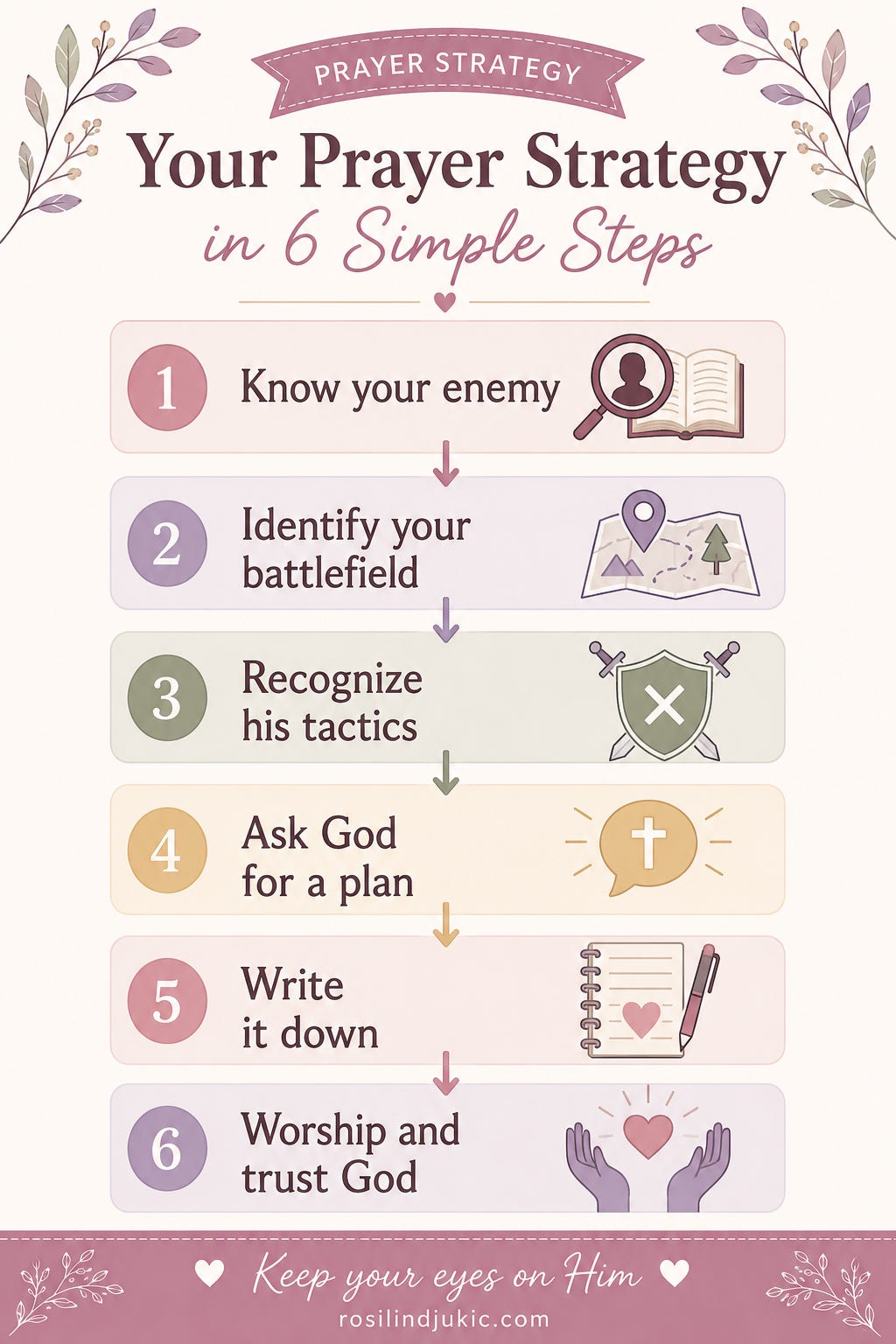
If the Son of God intentionally sought the Father before major decisions and difficult battles, how much more should we?
I’ve learned that one of the most helpful things I can do is stop praying in vague generalities and start asking God very specific questions.
“Lord, where am I vulnerable?”
“What lie have I been believing?”
“What does Your Word say about this battle?”
“What step of obedience are You asking me to take today?”
Those kinds of prayers have changed me far more than simply asking God to make the problem disappear.
Prayer isn’t just about asking God to fix our circumstances.
It’s about allowing Him to transform us in the middle of them.
That’s why I recently put together a simple Prayer Strategy Worksheet that walks through the process I use whenever I’m facing a spiritual battle. It’s not a formula, and it certainly isn’t magic. It’s simply a practical tool that helps me slow down, seek God’s wisdom, and pray with greater purpose.
Each one of the six steps in the infographic above deserves a little explanation, which is why I put together a complete Bible study and a free Prayer Strategy Worksheet that walks through each one in detail.
If you’ve ever wondered what it actually means to “write out your prayer strategy,” I think it will encourage you.
If you’ve ever wondered what people mean when they talk about having a “prayer strategy,” I think it will encourage you.
You can read the full article and download the free Prayer Strategy Worksheet here.