


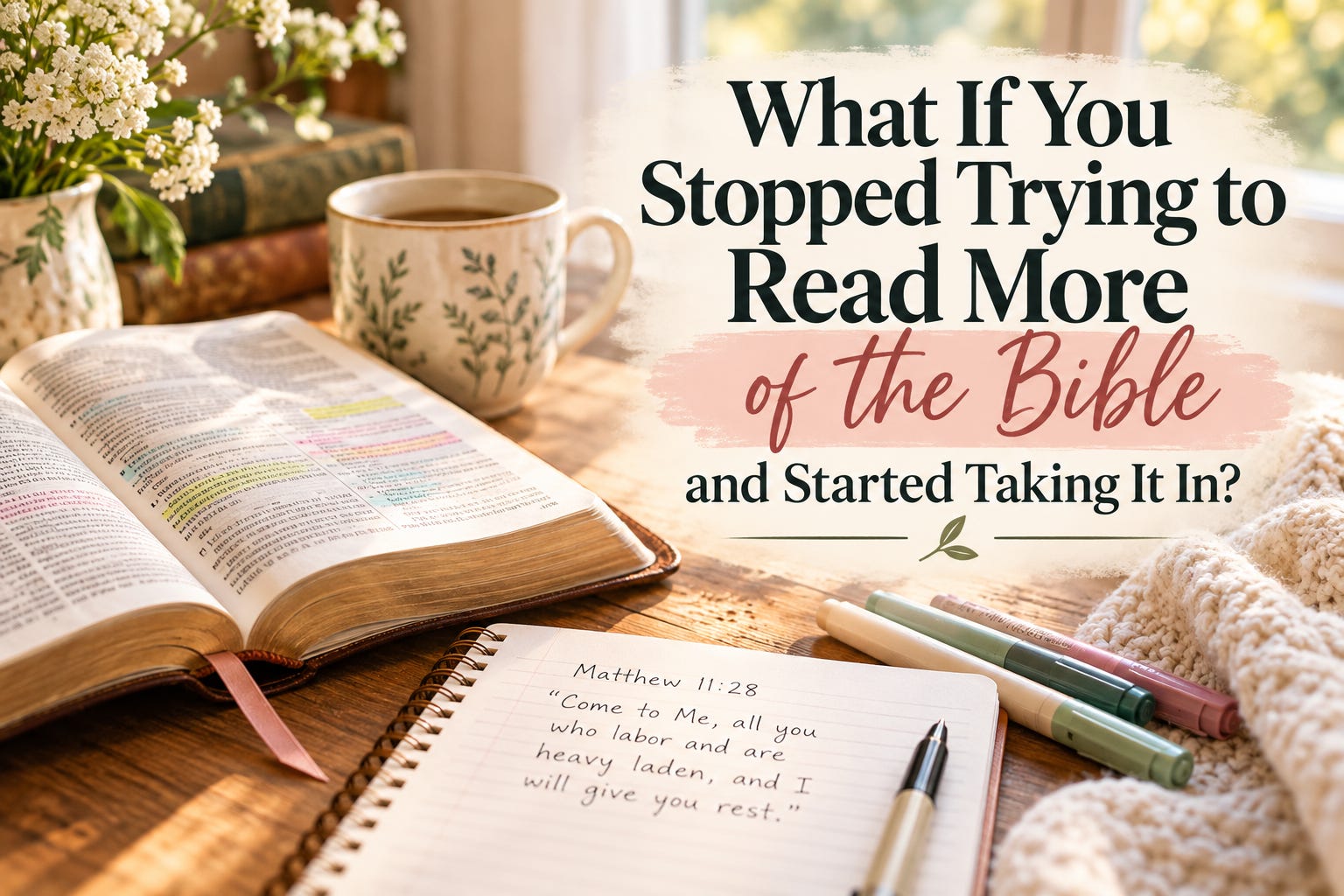
Have you ever finished your Bible reading for the day only to realize that you can’t remember much of what you just read?
You checked the box. You completed your reading plan. You moved on with your day.
But did the Word of God really make its way into your heart?
For years, I approached Bible reading as a doer. I come from a family of hard workers, and I’ve always been someone who knows how to get things done. Give me a task, and I’ll get busy.
But this year, God has been teaching me something that goes against my natural instincts: sometimes the most productive thing we can do is slow down.
And it has completely changed my quiet time.
You Don’t Have to Read Three Chapters a Day to Be Spiritual
There is nothing wrong with reading through the Bible in a year. I’ve known godly people who faithfully followed that practice, and it can be a wonderful way to become familiar with the whole counsel of Scripture.
But somewhere along the way, many of us begin to measure our spiritual lives by how much we read.
Three chapters a day. Five on Sunday. A completed reading plan. Another book checked off the list.
We can become so focused on getting through the Bible that we forget to let the Bible get into us.
This year, I’ve sometimes spent several days studying a single verse. I’ve read it, written it out, examined individual words, looked at its context, prayed over it, and returned to it repeatedly throughout the day.
And those verses have changed me.
The goal isn’t to accumulate Bible knowledge simply for the sake of knowing more. The goal is to know God through His Word and allow His truth to transform the way we think, live, and respond to the world around us.
How I Study One Verse Deeply
This year, I’ve been studying the biblical meaning of rest, beginning with the Hebrew word Shabbat and then exploring the New Testament.
One verse that has become especially meaningful to me is Matthew 11:28:
“Come to Me, all you who labor and are heavy laden, and I will give you rest.”
I began by reading the verse in my Bible. Then I wrote it out by hand in my notebook.
As I wrote, I noticed words I might otherwise have passed over. I asked questions about their meaning and considered how they connected to the rest of the passage.
I also used the Blue Letter Bible app to explore the original-language words and compare their uses throughout Scripture.
One important principle guides this process: I read and study Scripture for myself before consulting commentaries or other teachers. Those resources can be helpful, but they should supplement our own careful study of God’s Word rather than replace it.
You don’t need an elaborate setup to begin. A Bible, a notebook, and a pen are enough.
Find all my favorite resources in one place in my Amazon Storefront
A BibleColored pens or pencils if you enjoy Bible journaling
Sticky notes or tabs for marking important passages
Here is a simple approach you can try:
Read slowly. Choose a verse or short passage and read it several times.
Write it out. Copy the Scripture into a notebook, paying attention to individual words and phrases.
Ask questions. What does this passage mean in its context? Why is this word used here? What does it reveal about God?
Study carefully. Compare related Scriptures and consult trustworthy study tools when you need help understanding the passage.
Pray over what you discover. Ask God to help you understand His Word and respond to it faithfully.
Return to the verse. Think about it later in the day. Let it shape your conversations, decisions, and responses.
If you want to learn more about studying Scripture in context, you can explore my other articles on Bible study and understanding God’s Word.
Let Scripture Follow You Throughout the Day
One of the most beautiful changes I’ve experienced is learning to carry a verse with me long after my Bible is closed.
I write it in my notebook. I reflect on it while doing ordinary tasks. I bring it up in conversations with my husband. I return to it in prayer.
Sometimes I spend two or three days thinking about a single verse because I still have questions about what it means.
And that’s okay.
Meditation on Scripture isn’t about emptying our minds. It’s about filling our thoughts with God’s truth and returning to it intentionally.
Psalm 1 describes the blessed person as one who delights in the law of the Lord and meditates on it day and night.
That kind of meditation takes time. It invites us to slow down, consider what God has said, and allow His Word to shape our inner lives.
If your thoughts often wander toward worry, discouragement, or feelings of inadequacy, learning to meditate on Scripture can also become part of renewing your mind.
You may find these articles helpful:
What Matthew 11:28 Taught Me About Rest
As I slowly worked through Matthew 11:28, I began to see myself in Jesus’ invitation.
“Come to Me, all you who labor and are heavy laden, and I will give you rest.”
I know how to work. I know how to take responsibility. I know how to keep going when there is still something left to do.
But I have had to learn that being faithful doesn’t mean carrying every responsibility without stopping.
Jesus doesn’t invite the weary to prove themselves by working harder. He invites them to come to Him.
He also says, “Take My yoke upon you and learn from Me, for I am gentle and lowly in heart, and you will find rest for your souls” (Matthew 11:29).
That invitation has been especially meaningful to me because I came from a background where rules, performance, and proving one’s spirituality carried enormous weight.
Jesus is gentle and lowly in heart. He doesn’t call us to earn His acceptance through spiritual performance.
Our quiet times aren’t another opportunity to prove how good we are at being Christians.
We come to the Word because we need Him. We come to learn from Him, know Him, and be transformed by Him.
Give Yourself Permission to Slow Down
If your quiet time has become a routine that feels dry, rushed, or mechanical, consider changing your approach.
You don’t have to abandon your reading plan. You don’t have to stop reading entire chapters. And you don’t need to feel guilty if you spend several days in one passage.
Simply give yourself permission to slow down.
Read a little. Write a little. Pray. Ask questions. Meditate. Return to the passage tomorrow.
The question isn’t how many verses you can finish today.
The question is whether you are making room for God’s Word to take root in your heart.
A Simple Invitation for Tomorrow’s Quiet Time
Choose one verse. Read it slowly. Write it out. Ask God to help you understand it. Then carry that verse with you throughout the day.
Let it become part of your prayers, your thoughts, and your responses.
You might be surprised by how much God can teach you when you stop rushing to the next passage.
The goal isn’t simply to read the Word of God. It’s to let the Word of God change you from the inside out.
What would happen if you spent a little less time trying to get through your Bible and a little more time letting its truth get into you?
Amazon Affiliate Disclosure
As an Amazon Associate, I earn from qualifying purchases. This means that if you click on an Amazon link and make a purchase, I may earn a commission at no additional cost to you. I only share products I believe may be helpful to you.
This was a really enlightening read. I thank you 🙏🏾